
Elementary school
Kindergarten – 5th Grade
Where curiosity grows, confidence develops, and students build a strong academic and spiritual foundation.

Parents aren’t just looking for academics. They’re looking for a place where their child will be known, encouraged, and inspired to grow.
At Rancho Christian Elementary School, students in Kindergarten through 5th grade build strong foundations in learning, faith, and character within a Christ-centered community that truly knows them.
Here, curiosity is encouraged, friendships are formed, and students begin discovering the gifts and purpose God has placed in them.
At Rancho Christian Elementary, students experience:
Strong academic foundations in reading, writing, math, science, and critical thinking
Teachers who know each student personally and care deeply about their growth
A Christ-centered environment that integrates faith into everyday learning
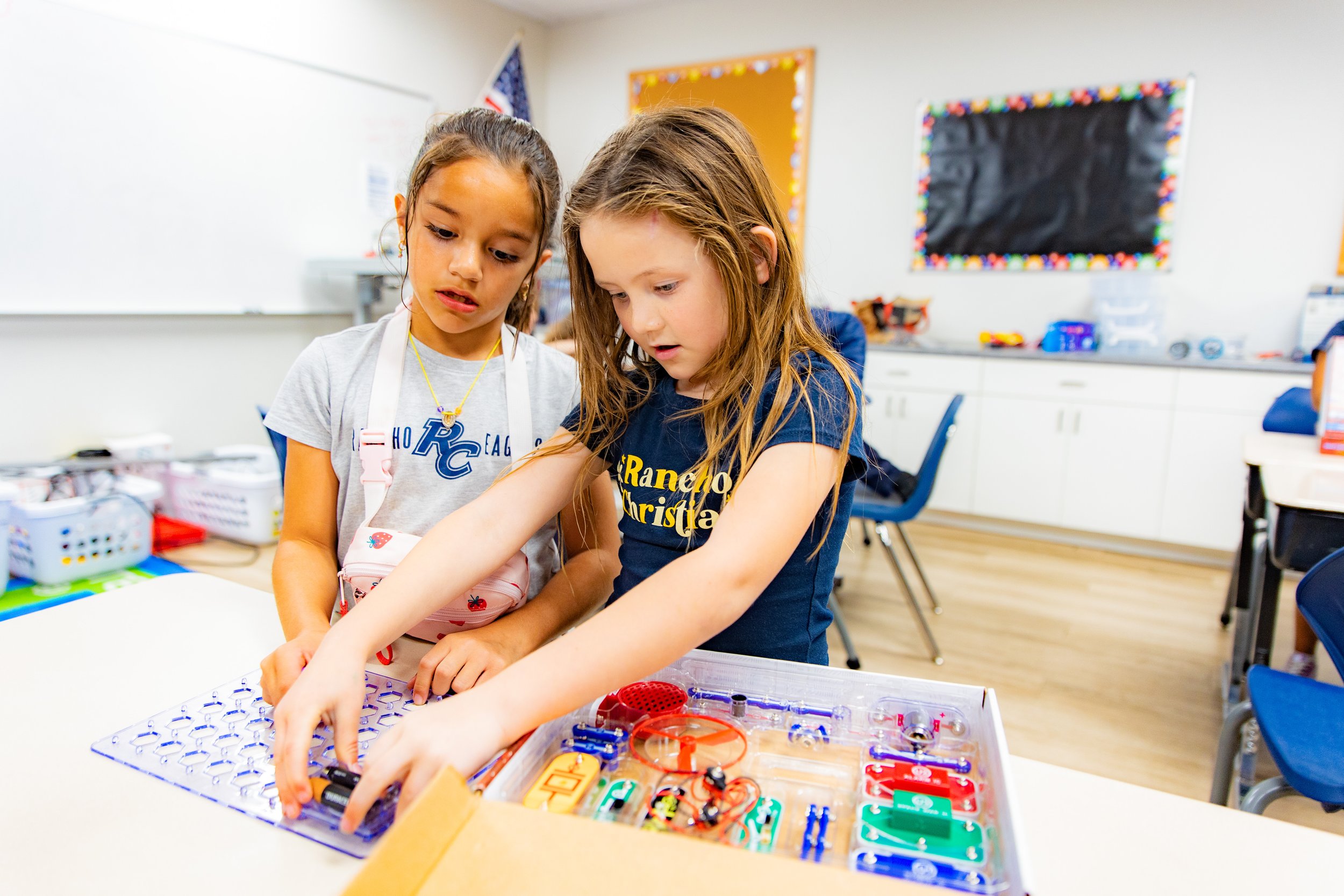
Hands-on learning through projects, field trips, and interactive lessons
Opportunities to explore creativity through arts, music, and enrichment
A safe, welcoming campus where students feel known and supported
Elementary school is one of the most important seasons in a child's development.
During these years students are not only learning academic skills. They are developing:
Confidence
Curiosity
Character
Friendships
A love of learning
At Rancho Christian, we intentionally nurture the whole child academically, socially, emotionally, and spiritually.
“Let the little children come to me, and do not hinder them, for the kingdom of heaven belongs to such as these.” Matthew 19:14


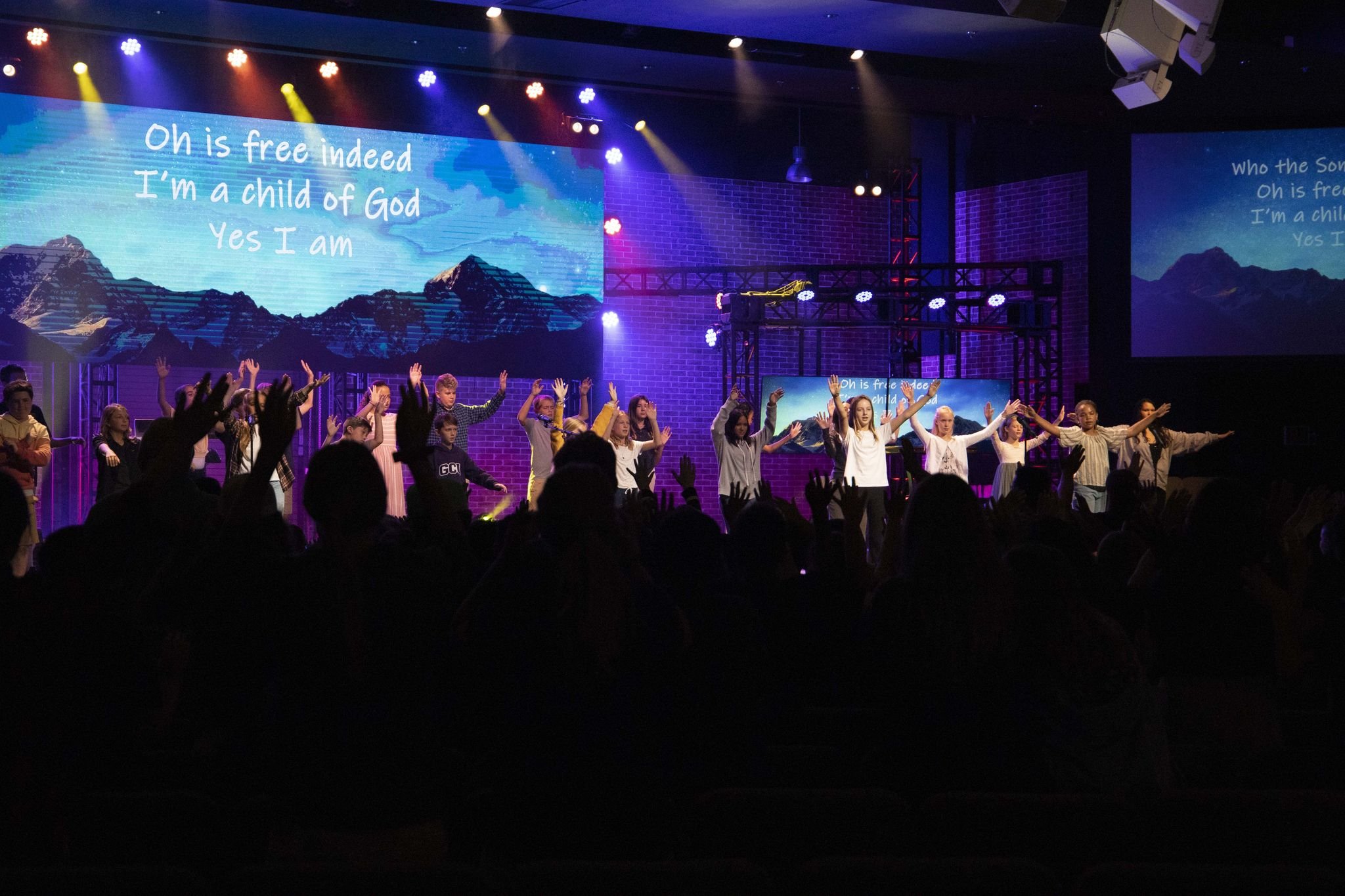
Faith is woven into the daily life of Rancho Christian Elementary, shaping not only what students learn but who they are becoming. Each day, students experience opportunities to grow spiritually through classroom prayer, moments of devotion, and Bible-centered learning that helps them understand God’s love and truth in ways that are meaningful for their age. Weekly chapel gatherings bring the elementary community together in worship, teaching, and encouragement, reminding students that their faith is something to live out both inside and outside the classroom. Throughout the year, students also participate in service opportunities that help them develop a heart for others and begin to understand the joy of serving their community.
Beyond structured moments of worship and learning, faith is expressed in the everyday culture of the school. Teachers model kindness, patience, and encouragement, helping students learn how to treat one another with compassion and respect. In classrooms, on the playground, and across campus, students are guided to practice Christlike character as they grow in friendship, responsibility, and empathy. This intentional environment helps students begin developing the habits of faith that will shape their lives long after elementary school.
At Rancho Christian, our goal is not only academic excellence but the formation of young people who know they are loved by God and called to live with purpose. We want every student to grow into a confident and compassionate leader whose life is grounded in faith.







Preparing Students for Middle School and Beyond
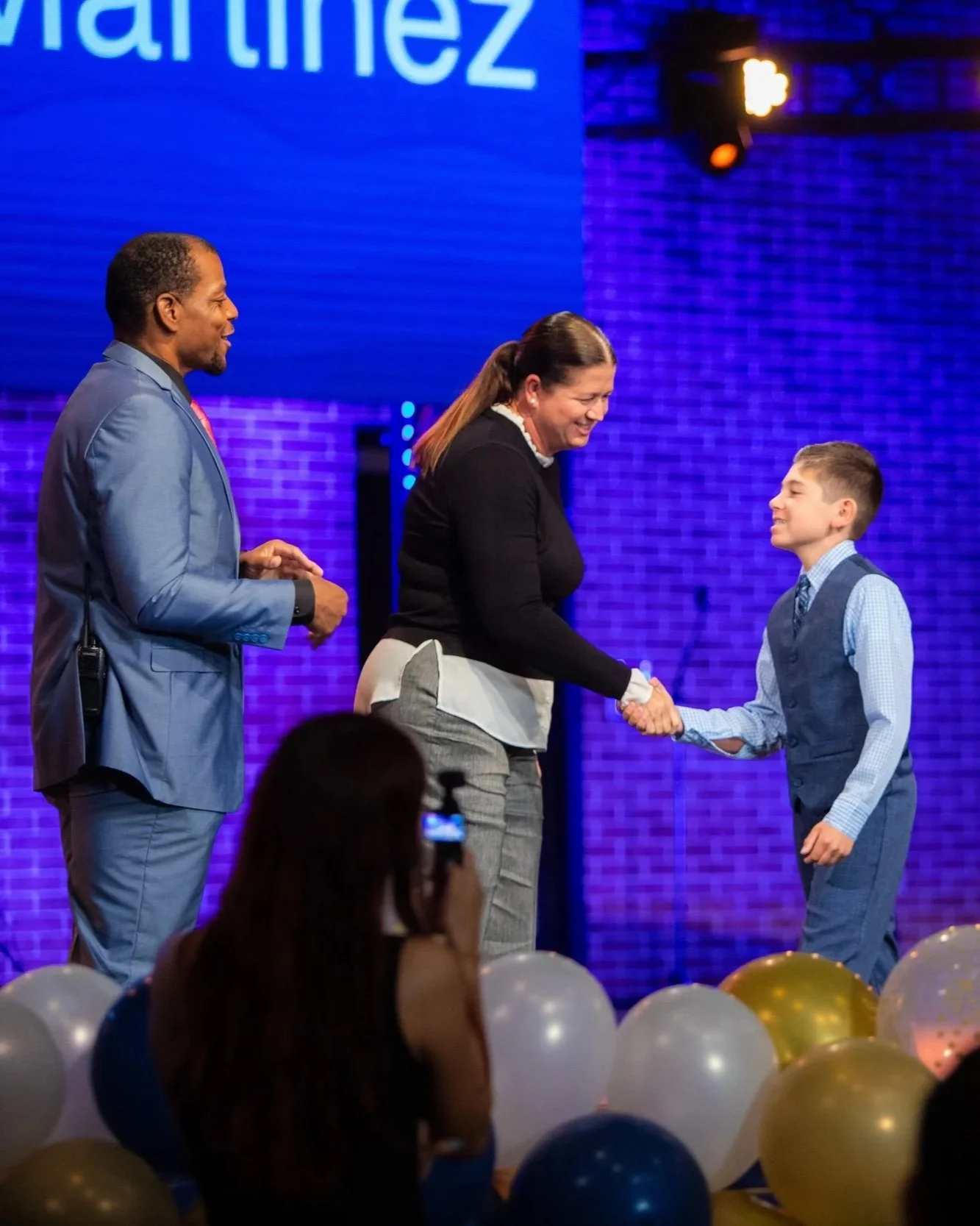
Elementary students graduate from Rancho Christian prepared for the next stage of their journey.
By the end of 5th grade, students have developed:
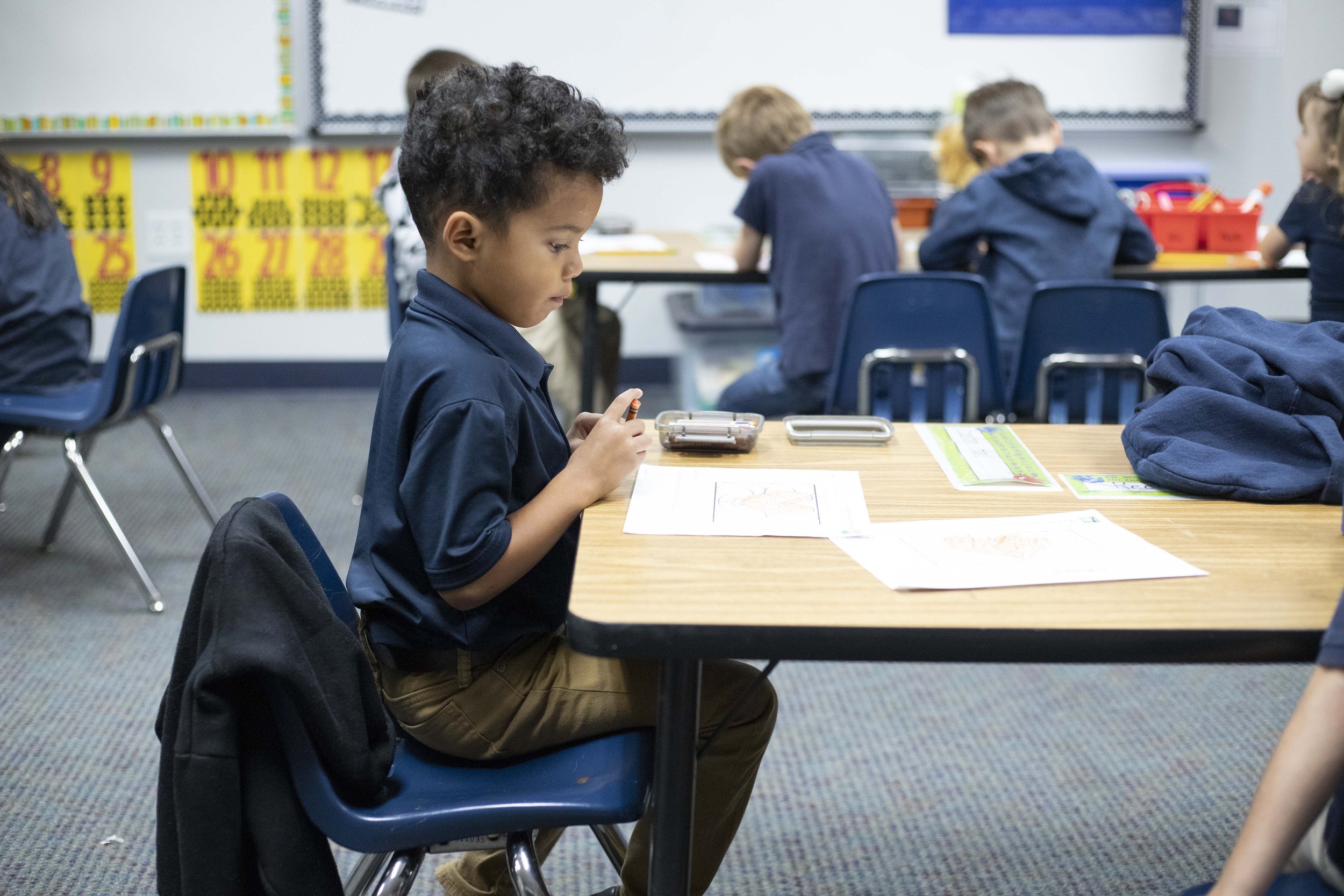
Strong academic habits
Independent learning skills
Confidence in the classroom
Leadership and teamwork
A foundation of faith that will continue into middle school
Students then transition into Rancho Christian Middle School (Grades 6–8) ready to grow even further.
campus life
Learning at Rancho Christian Elementary extends far beyond the classroom walls. While students build strong academic foundations each day, they are also given opportunities to explore creativity, discover new interests, and engage with the world around them. Through a variety of enrichment experiences, students are encouraged to grow not only as learners but as confident individuals who enjoy the process of discovery.
Creative expression plays an important role in campus life. Students participate in arts and music programs that allow them to develop their talents, build confidence, and experience the joy of creating and performing. These opportunities help students explore their imagination while also learning discipline, collaboration, and appreciation for the arts.
Technology is thoughtfully integrated into the learning environment to support academic growth and prepare students for the future. Teachers use technology as a tool to enhance learning, encourage problem-solving, and help students engage with lessons in interactive and meaningful ways while still maintaining a healthy balance with hands-on learning.
Throughout the year, students also experience learning beyond the campus through field trips and special events that connect classroom lessons to real-world experiences. These opportunities spark curiosity, deepen understanding, and create memorable moments with classmates and teachers.
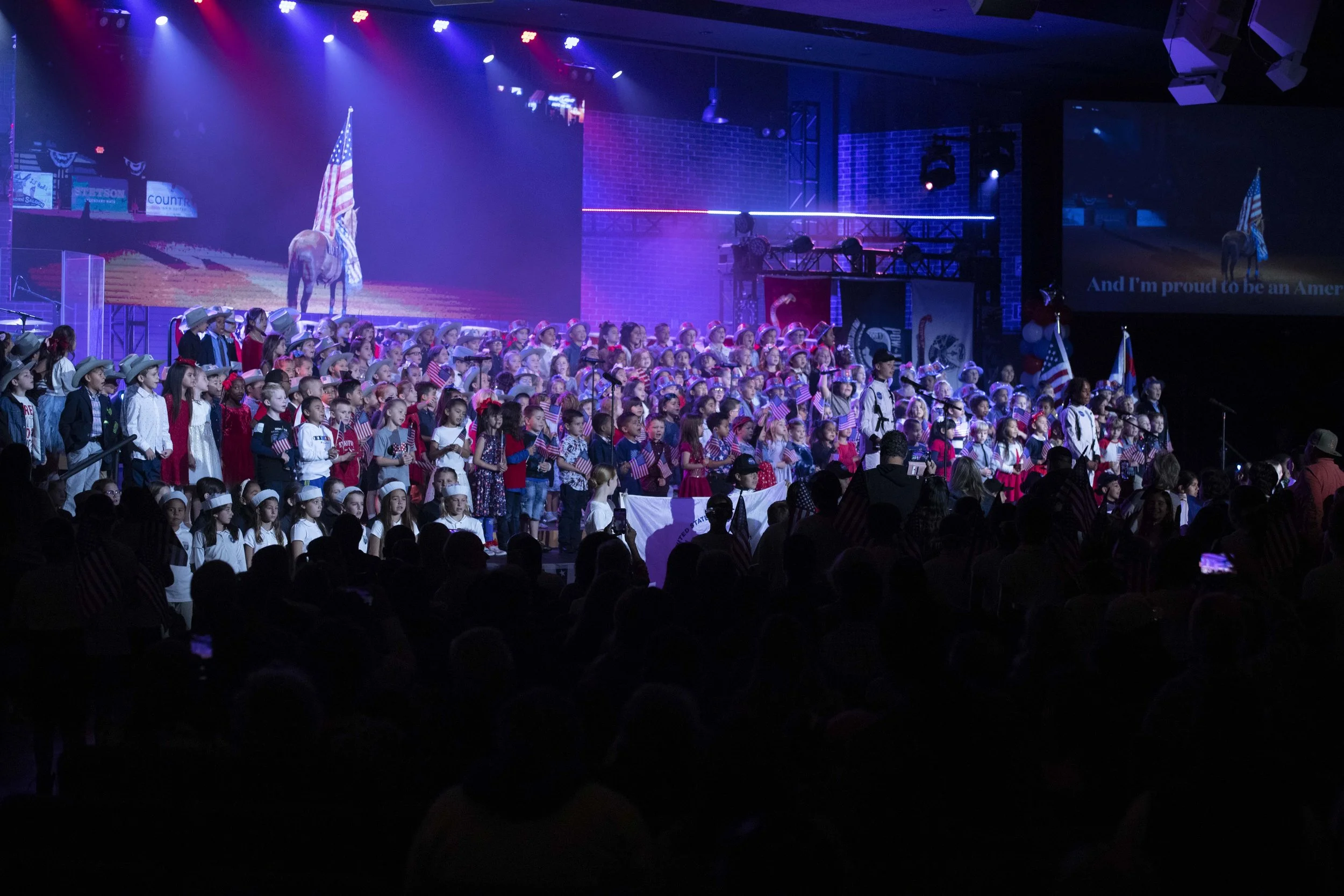
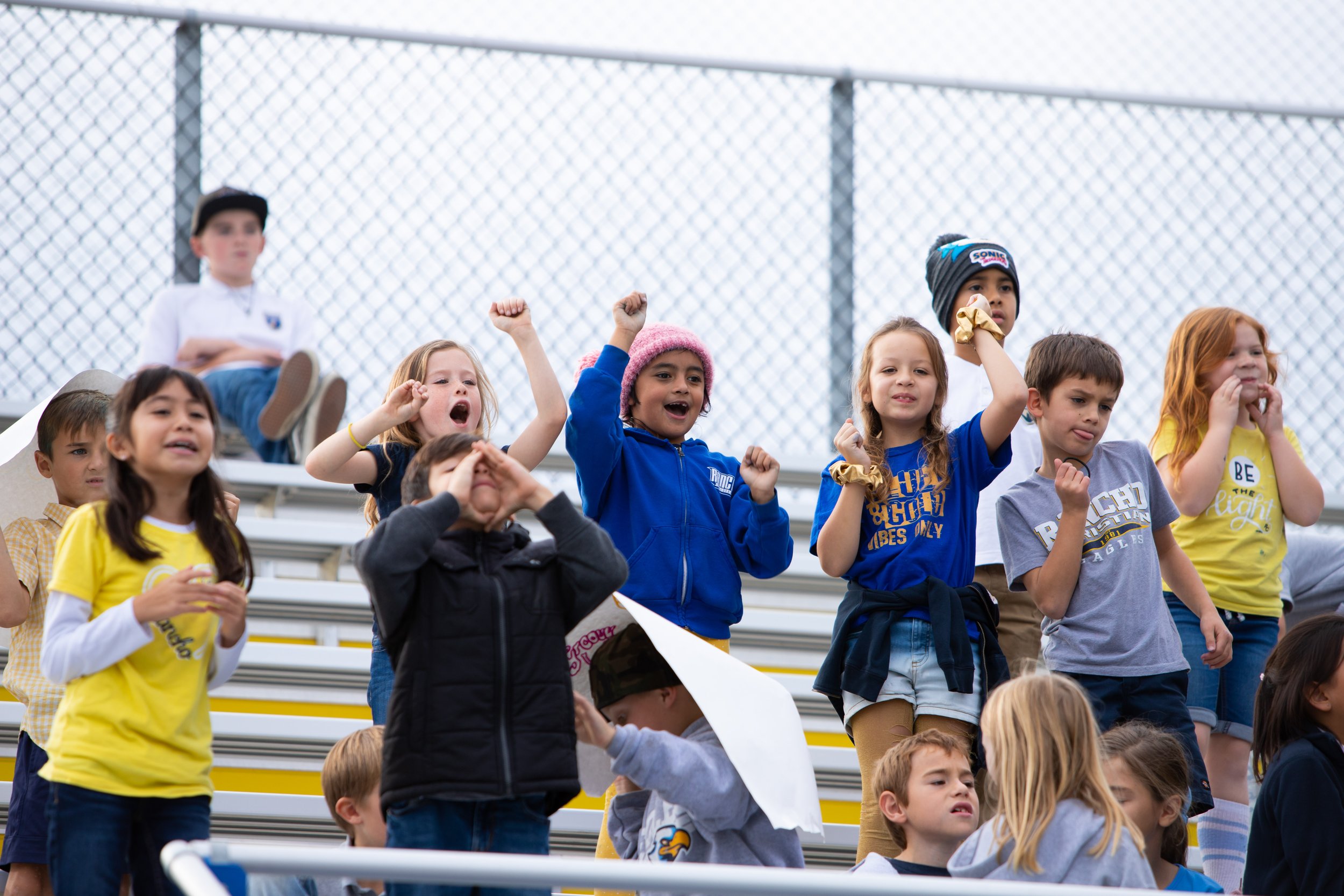
Campus life is also shaped by moments that bring the community together. Chapel gatherings, school events, and shared celebrations create a sense of belonging and remind students that they are part of something larger than themselves. These experiences help build friendships, strengthen community, and reinforce the Christ-centered values that guide daily life at Rancho Christian Elementary.
elementary enrichment
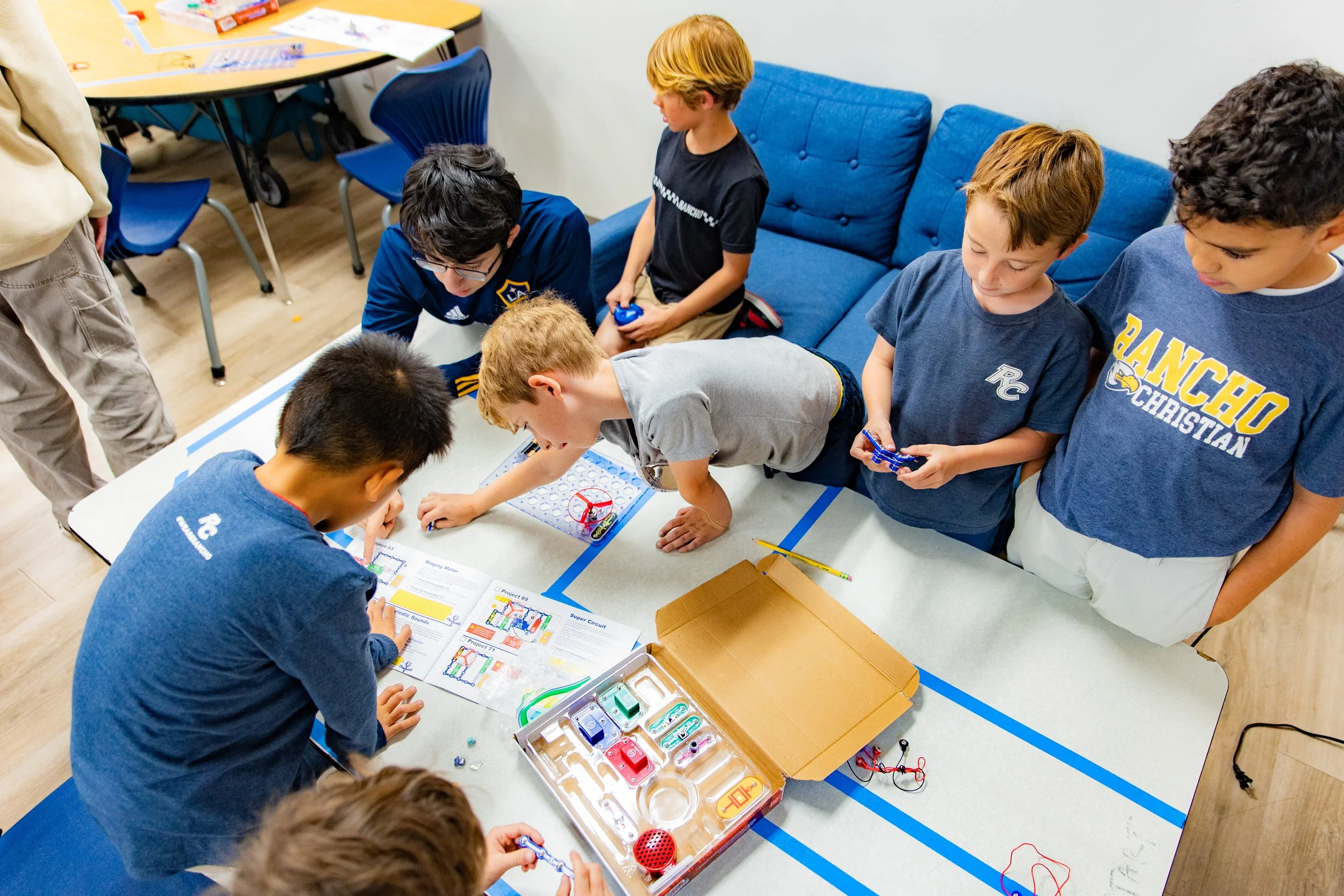
Rancho Christian’s Enrichment Department provides families with a meaningful after-school option that goes far beyond traditional childcare. Designed to support working families, the program allows students to remain on campus in a safe, structured environment where they continue to experience the same Christ-centered culture that defines the school day. Rather than simply supervising students after dismissal, the Enrichment program offers engaging activities that encourage creativity, collaboration, and exploration while giving students opportunities to build friendships and enjoy their time on campus.
Through a variety of fun and educational experiences, students participate in activities such as games, creative projects, outdoor play, and guided learning opportunities that keep them active and engaged. The program allows children to unwind after the school day while still benefiting from a positive and supportive environment led by caring staff who know and value them. For many families, the Enrichment Department provides both flexibility and peace of mind, knowing their children are continuing to grow, learn, and be part of the Rancho Christian community even after the final bell rings.
Choosing the right school for your child is an important decision, and we would love to help you experience Rancho Christian firsthand.
Schedule a campus tour and discover how Rancho Christian Elementary can be the place where your child learns, grows, and thrives.
grade level curriculum guides
-
In the Kindergarten program, we begin to build students foundational skills. Students learn about the world God has created. Each student begins to develop key skills in both academic and social settings. This is where a Christ centered journey of lifelong learning begins.
Bible (Purposeful Design)
A Biblical foundation is essential to the mission of Rancho Christian School. Our Bible classes prepare our students for living the Christian life, and are a guide to help them become grounded in and shaped by God’s Word.
Familiar Bible Truths that emphasize God’s loving care
Creation, The First Family, Noah
Abraham, Isaac, Jacob, and Joseph
Salvation
The Life and Ministry of Christ
Language Arts (Open Court Reading)
God reveals Himself through language. The study of language enables our students to gain knowledge, explore ideas, and communicate effectively. It is an integrated study of literature, phonics, reading, writing, listening, and speaking. Through the study of language, we strengthen our relationship with God, and are able to communicate His message to others.
Phonics:
Recognition and sounds of consonants, vowels and blends
One and two vowel words
Phoneme blending, isolation, substitution, matching, pronunciation
Segmentation
Writing:
Proper formation of letters
Sentence structure
Punctuation
Introduction to creative writing
Introduction to book reports
Reading:
Print and Book Awareness
Beginning high frequency words-mastery
Series of readers to equip students to read with fluency and expression
Comprehension and critical thinking
Simple Chapter Books for students who complete the kindergarten reading series early
Language Arts Centers
Reading Buddies (cross aged reading partners)
Mathematics (Dimensions)
The Christian approach to teaching Kindergarten mathematics reflects order and structure, because our world was created by an orderly God. Students will discover exactness, preciseness and completeness in the subject matter of mathematics, just as would be expected in God’s world. Students will gain the foundational skills of conceptual understanding of numbers by exploring numbers through pictorial representations
Number sense 1-100
Introduction of addition and subtraction
Abstract concepts: time and money
Calendar skills
Critical thinking with problem solving
Social Studies/History (Studies Weekly)
Students are introduced to United States and world geography from a Biblical worldview; as well as the cultures of people of other countries. Our curriculum also teaches that God loves them as well as children all over the world.
Community Helpers
America: Our Great Country
Children of the World
Science (Mystery Science/Generation Genius)
God is the creator of all things living and nonliving. God’s glory and His character are revealed through exploration, observation, and scientific study of His world.
God’s Incredible Design: Me
Weather, Seasons and Space
Plants and Seeds
Animals
Ocean Life
Supplemental Events and Activities
Kindergartners learn through a variety of experiences that will enhance all learning modalities. Our supplemental events complement and enhance our solid curricular foundation which is developmentally and age appropriate.
Apple Fun Day
Winter Fun Day
Science Day
100th Day of School
Easter Hat Parade
Dr. Seuss and Read Across America
Space Camp
International Day
-
First grade students are taught the skills of being an independent learner and a collaborative team member. Teachers differentiate lessons in order to celebrate the skills with which God has blessed each student. Excellence is encouraged in each classroom. Through these experiences, students begin to prepare for the plan God has for each of them.
Bible (Purposeful Design)
We study the Bible with an emphasis on discovering familiar Bible truths that emphasize God’s relationship to people. We will also be studying the underlying Scripture basis for each belief statement in addition to memorizing Scripture. The goal for students is to develop a Christian worldview and realize that the primary reason for living is to love and serve God. This occurs through knowledge and application of Scripture.
God’s Great Story of Truth and Love
Plan of Salvation
Spiritual Growth in Christ
Bible Study, Prayer & Worship
Language Arts (Open Court Reading)
Students in first grade receive comprehensive instruction in mastering the foundational components of language skills, including reading proficiency and the beginning elements of effective writing.
Phonics:
Orally taught phonics sounds
Application of sounds in reading and writing
Sound/Spelling connection
Special Vowels Teams, dipthongs, digraphs, r-controlled, silent letters
Grammar:
Capitalization & punctuation
Sentence structure
Correct word use
Writing:
Journal writing
Complete sentences and short stories
Penmanship and correct pencil grip
Reading:
Comprehensive phonics and spelling
High frequency word and vocabulary development
Open Court decodables support progressive reading proficiency and comprehension
Literature units
Mathematics (Dimensions)
First graders learn to master a received body of knowledge and apply it. The math curriculum is focused on mastery, which is achieved through intentional sequencing of concepts. Some key features of the Dimensions approach include Concrete, Pictorial, Abstract progression, number bonds, bar modeling and mental math. Students will learn to think mathematically and rely on the depth of knowledge gained throughout their lessons.
Place value
Addition and subtraction
Money, time, and measurement
Fractions
Problem solving and logical thinking
Social Studies/History (Studies Weekly)
Our social studies curriculum lays the foundation for patriotism and stimulates the students’ appetite for learning about America and other countries around the world. In addition, the students are introduced to geography.
American Symbols and Freedoms
My America Travels
Beginning World Travels
International Day
Science (Mystery Science/Generation Genius)
First graders learn about the universe as the direct creation of God. The curriculum is presented with the belief that God is the Great Designer and Lawgiver, without Whom the evident design and laws of nature would be inexplicable.
Discovering Myself
Simple Machines
Animals and Insects
Plants and Seasons
Science Day
-
Second grade students take the foundational skills acquired in first grade and begin to apply them in more complex concepts and situations. Students are taught with a variety of strategies to take into account each student’s learning style. Differentiated instruction is offered to assure that every student is being challenged and working up to his/her potential.
Bible (Purposeful Design)
Second graders take a more detailed look at the studies of the character traits of various people in the Bible. Through object lessons, activities, and discussion teachers help children to understand the gospel presented in the New Testament. Students memorize scripture weekly. .
Language Arts (Open Court Reading)
Students learn language with a balanced approach: memorizing essential grammar in phonics, sentence structure, and paragraph formation. They then apply these language skills in reading, discussing and writing about literature, history, and science concepts.
Phonics:
Review of phonics foundations
Word Analysis skills - synonyms, antonyms, comparatives, superlatives, homophones, irregular plurals, multiple meaning words
Inflectional endings, multisyllabic words, r-controlled vowel spellings
Grammar:
Capitalization
Punctuation
Parts of speech
Prefixes and suffixes
Writing:
Key Word Outlines
Summarizing
Paragraph writing
Stylistic techniques
Journal writing
Cursive
Reading:
High frequency words
Book reports
Novels: The Hundred Dresses, Trumpet of the Swan, My Father’s Dragon, Mrs. Piggle Wiggle
Mathematics (Dimensions)
Students are taught to take concepts previously learned to a more complex level. The math curriculum is focused on mastery, which is achieved through intentional sequencing of concepts. Some key features of the Dimensions approach include Concrete, Pictorial, Abstract progression, number bonds, bar modeling and mental math. Students will learn to think mathematically and rely on the depth of knowledge gained throughout their lessons.
Math fact memorization (+,-, x)
Place value to hundred thousands
Problem solving
Time/Money Measurement
Multiple unit addition/subtraction with regrouping
Social Studies/History (Studies Weekly)
Second graders focus on the United States and the people who built it. Students also learn the location of all states, oceans, and continents.
States, Patriotic Holidays and Songs
Separatists, Indians, Colonists, Pioneers and Cowboys
Native American home project
1620 Day
International Day
Science (Mystery Science/Generation Genius)
Students’ interests are stimulated through the study of God’s creation.
Animal World
Plant World
Things that Move
The Air Around Us
Earth and Sky
Experiments
Science Day
-
Third grade students are introduced to many opportunities to develop critical thinking skills during this transitional year between primary and upper elementary. Our goal is to develop students that can think critically, solve multistep problems and apply Biblical principles to their academic and social lives.
Bible (Purposeful Design)
We study the Bible with an emphasis on discovering how Jesus and the Gospel is the central message of each book. In third grade students will be looking at studies in the life of Christ, the early Church and missions from the time of Paul until now. We'll also be studying the underlying Scripture basis for each belief statement.
Language Arts (Open Court Reading)
Students will learn to apply grammar skills to their creative writing in a consistent manner in order to communicate effectively in all subjects.
Students will develop oral reading fluency. They will participate in class discussions on what they read and Biblical principles will be integrated into reading time as students make real world connections with the characters.
Grammar:
Capitalization
Punctuation
Basic sentence structure
Word usage
Prefixes, suffixes, Greek & Latin roots
Spelling/Vocabulary:
Students will learn to expand critical grade-level vocabulary and utilize content-area academic reading, writing and speaking.
Shades of meaning/Levels of Specificity
Writing:
Key Word Outline (for brainstorming and text exposition)
Seasonal and holiday writing
Responsive journal writing
Book reports
Poetry (haiku and acrostic styles)
Reading:
The BFG
Charlie & the Chocolate Factory
Because of Winn Dixie
Charlotte’s Web
Tale of Despereaux
Mathematics (Dimensions)
Third grade students will use their knowledge of facts in a variety of multistep processes. The math curriculum is focused on mastery, which is achieved through intentional sequencing of concepts. Some key features of the Dimensions approach include Concrete, Pictorial, Abstract progression, number bonds, bar modeling and mental math. Students will learn to think mathematically and rely on the depth of knowledge gained throughout their lessons.
Addition and subtraction to the thousands
Multiplication and division facts through 12’s
Long division to the thousands
Measurement and conversions
Social Studies/History (Studies Weekly)
The study of American history (from New World exploration through the 1900’s) in a biographical format.
History Field Day (activity based event that reviews history concepts)
Geography (continents, maps, grids, directions, map keys)
Science (Mystery Science/Generation Genius)
The study of God’s world.
Plants (research using school garden)
Weather
Five senses
Animals within various habitats
-
Fourth grade students are challenged to be critical thinkers while solving real world problems by applying God’s truths into each situation. Within each classroom, teachers use a variety of teaching styles to allow students to learn using different methods including hands on activities and projects.
Bible (Purposeful Design)
Students are digging deeper into the basic doctrines of the Church, Students use common stories to develop and discern the true meaning within the context of the Bible. students recognize how Christ is the center of every story. Students are told why sins have consequences, but also about how the love of Christ can provide healing and salvation to a lost world.
Language Arts (Open Court Reading)
Students continue to demonstrate understanding of facts and ideas by organizing, comparing, inferring, and applying knowledge of key concepts.
Grammar:
Capitalization
Punctuation
Diagramming
Eight parts of speech
Sentence structure
Writing:
Fables
Native Americans
California Missions
Summaries
Compare and Contrast
Persuasive paragraphs
Spelling/Vocabulary:
Students will learn to expand critical grade-level vocabulary and utilize content-area academic reading, writing and speaking. Students will spell high frequency words correctly.
Reading:
Narnia Series
Mathematics (Dimensions)
While building on the foundational concepts such as addition, subtraction, multiplication and division, students solve complex problems in a variety of forms. Students coming into fourth grade should be proficient in multiplication and division facts. The math curriculum is focused on mastery, which is achieved through intentional sequencing of concepts. Some key features of the Dimensions approach include Concrete, Pictorial, Abstract progression, number bonds, bar modeling and mental math. Students will learn to think mathematically and rely on the depth of knowledge gained throughout their lessons.
Two and three digit multipliers
Two digit divisors
Fractions
Geometry
Social Studies/History (Studies Weekly)
Fourth grade students study the history of California from the Native Americans to present day.
Geography of California
Native Americans
Missions
Gold Rush
California History Project
Science (Mystery Science/Generation Genius)
Students continue to build on previously learned concepts. Students conduct an individual Science Fair project.
Scientific Inquiry
Science Fair
Changes to the Earth’s Surface
Plants and Animals
Rocks and Minerals
Scientist of the Week
-
Bible (Purposeful Design)
Textbook: Purposeful Design by ASCI
Our desire through this curriculum is to help students find knowledge, wisdom, and understanding of Jesus in the Old Testament
Studies in the Old Testament that emphasize choices and their consequences
Old Testament survey with an emphasis on the gospel message
Weekly Bible Verses which teaches essential Christian doctrines
Language Arts (Open Court)
Through an integrated study of literature, writing, listening, speaking, and grammar; students gain knowledge, explore ideas, and communicate effectively. This allows them to strengthen their relationship with God and better share His message to others.
Grammar:
Eight parts of speech
Sentence structure and diagramming
Master punctuation, capitalization, and subject/verb agreement in all writing.
Spelling/Vocabulary:
Students will learn to expand critical grade-level vocabulary and utilize in content-area academic reading, writing and speaking. Students will spell high frequency words correctly and work to identify the latin and greek roots of words in order to spell larger words correctly.
Reading:
Students will read a variety of novels and respond weekly through diverse writing assignments, vocabulary quizzes, and comprehension quizzes.
Writing:
Students will learn to:
Research information and organize material properly through the use of graphic organizers, outlining techniques, and note taking.
Compose five paragraph essays on both literature read and topics researched.
Use stylistic techniques to create quality essays.
Complete a research project. It will include researching five sources of information, writing a two to three page paper, and preparing a powerpoint presentation.
Mathematics (Dimensions)
Textbook: Dimensions by Singapore Math
The students receive instruction in basic mathematical functions and problem solving. Review and master concepts studied in fourth grade.
Perform basic operations with fractions and decimals
Geometry, probability, and story problems
Solve multi-step problems
Utilize critical thinking skills
Review and master concepts previously studied
Perform basic operations with fractions, decimals, ratios, and percents
Integers, coordinates, and life application
Continued application of critical thinking skills
Multi-Step problem solving
Social Studies/History (Studies Weekly)
The students will study American history from a Christian perspective beginning with Native American tribal groups up through the Civil Rights Movement in the 1960’s.
Geography of the United States
Native Americans
Revolutionary War
African American
Oregon Trail
Science (TCI)
Textbook: TCI
The students investigate a variety of areas in the field of science with an emphasis on God as the Creator
Science Inquiry
Physical Science
Earth Science
Life Science
Computer Science
Engineering
Computer Science: Rancho Christian School equips students to function in a technical society. Students practice application of the basics of computer science with drop and drag programming as well as coding, document creation, spreadsheets and presentation software. The use of technology is integrated across subject areas. Careers in computer science will be discussed.
Astronomy: This course provides a basic introduction to the exciting field of astronomy. The course will cover astronomy, planets, stars, galaxies, black holes and planetary motion. Students will also be able to identify different types of telescopes and have exposure to using the school’s power telescope. Students will begin to understand the purpose of an observatory and how an observatory enables us to see beyond our own planet. Careers in the field of astronomy and exploration will be discussed.
Math & Science Lab: Students will investigate life and earth sciences in the lab utilizing the scientific method. Students will also apply mathematical principles and problem solve real world situations in exercises that stimulate and develop critical thinking